
The dreaded waist gap.
Everyone has had a pair of jeans like this. You do them up, they look great from the front, and the back of the waistband is standing away from your body, leaving a gap big enough to post a letter through. Sometimes it only shows when you sit down, and sometimes it's sitting there gaping at you while you're stood up.
If you're developing jeans for your brand and this shows up on your fit sample, it's easy to think "the waistband is gaping, I need to make the waistband smaller!"
STOP RIGHT THERE.
It might be the waistband. It could be a number of other things. It's by far the number one fit comment I make on jeans, and very often the problem is somewhere else entirely.
Why taking the waist in doesn't always fix it
When something gapes, the natural instinct is to take fabric out. The waist is too big, so make the waist smaller. Simple.
Except you can end up with a waistband that's now too tight at the front and still standing away from the back, because the thing pulling it out of place hasn't changed.
Often when a garment is too small, we add more fabric in. With the rise, it's not necessarily about adding more fabric, it's about changing the shape to create space in the right place.
What is the back rise?
The back rise is the seam that goes around your bum, from the fork (where the legs meet in the crotch) up to the back waistband.
Its shape matters a lot more than people think, and you won't see it by measuring the jeans. You've got to take a look at the pattern. There needs to be enough space in that curve for a bum to fit. If there isn't, the bum fills the space anyway, and in doing so starts pulling the waistband out and down. Hello, waist gap.
How to see the back rise shape without the pattern
"I don't have the pattern, the factory has the pattern!" I hear you cry.
Well, there's a trick.
Take one leg and turn it inside out.
Put your arm inside the other leg.
Push that leg down into the inside-out leg, so both legs sit inside each other.
Lay it flat and look at the curve of the seam that runs from the waistband down to the crotch.
That curve is the shape of your rise. It's much easier to see than it is to describe, so here's how to do it.
Once you can see it, think about the shape of a body. Is there a nice curve that gives the bum somewhere to go, or does the seam look a bit flat and straight?
So how do you fix it?
On the last pair of jeans I fitted with this problem, the rise needed a little more scooping out around the curve. That gives the bum somewhere to sit without having to drag the waistband with it.
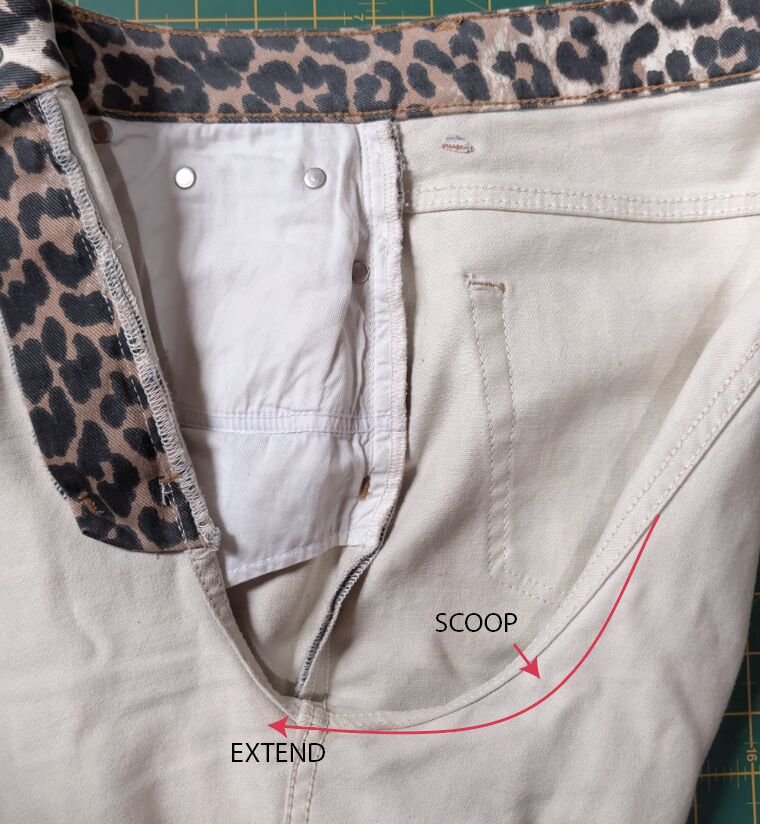
Depending on how much the waist is pulling down, you may also need to look at extending the length of the rise AT THE FORK! Not under the waistband!
That bit is important. If you add length at the top, you're just adding more fabric where you already have too much. Adding it lower down, at the fork, gives the jeans more room where the body actually needs it.
How much to scoop and how much to extend depends on the jeans, the fabric and how they look on a body. This is where a proper fit session earns its keep, because you need to see it on a person, not just on a measurement chart.
It might not be the pattern at all
Sometimes the pattern is fine and the problem is how the jeans have been sewn.
The back rise on jeans is usually a flat-felled seam, and it's a curve. If the machinist sews it in a straight line, it cancels out the curve that was drafted into the pattern. All that lovely space you carefully created for the bum disappears, the waistband stands away at the centre back, and the front waistband often feels tight at the same time.
Straightening curves to make sewing quicker and easier happens more often than you'd think, and it distorts both the fit and the measurements.
The fix is to sew the seam following the curve of the pattern, so the curve is actually sewn into the jeans and stays there through the wash.
This is why I'd always look at the actual garment as well as the pattern. If the pattern has the right shape but the jeans don't, changing the pattern again won't help. The factory needs to know how the seam should be sewn.
Other things that can cause waist gap
It isn't always the rise. When I see a gaping back waist on a fit sample, these are a few of the other things I'll be looking at:
The yoke. The shape of the yoke (the V-shaped panel across the back, under the waistband) has a big effect on how the back fits. That's a whole other post.
The waistband shape. A completely straight waistband sitting on a curvy body can stand away at the back. A shaped or curved waistband can follow the body better.
The fabric. Rigid denim and stretch denim behave very differently, and stretch denim that doesn't recover well can grow while it's being worn.
The grading. If the sample size fits beautifully but the gap appears in bigger sizes, your grading may not be adding room in the right places.
The fit model. Not every body is the same. If your fit model's shape is very different from your customer's, you could be fixing the wrong problem.
Write fit comments the factory can actually use
"The waist is gaping, please fix" isn't a fit comment. It's a wish.
The factory will most likely do exactly what you asked, take the waist in, and send you another sample with the same gap. Then you're paying for another sampling round and wondering whether you and the factory are even developing the same pair of jeans.
A good fit comment tells them what's happening, where, and exactly what to change. You need to be very specific about the point where the shaping should start and how much to add or take out. For example (numbers plucked out of thin air): "Back waist gaping at centre back when standing and seated, back rise too flat. At 4cm from the fork, scoop out the back rise by 1.5cm and shape to 0cm at the yoke. Extend back rise by 1cm at the fork. Please make sure the back rise seam is sewn following the curve, not straightened." Ideally with photos, and with the changes marked on the pattern or spec.
The bottom line
When your jeans gape at the back, don't automatically make the waistband smaller. Look at the shape of the back rise first. Is there enough space for a bum? Then check the jeans have actually been sewn with that shape.
Change the shape, not just the size, and put the room where the body needs it.
If your fit samples keep coming back with the same gap, or your customers keep sending jeans back because of it, I can help.